

Building Tomorrow’s Cities: How Data and Citizens Can Transform Urban Planning
 Dagmar Celuchova Bosanska
Navigation

A city is a complex organism, and public spaces serve as a mirror reflecting the health and vitality of its society. In the future, they will also reflect how well local governments have learned to work with data in the era of big data, generated by smartphone users, traffic sensors, and air quality monitors in the Internet of Things.
From Rigid Plans to Living Systems
The private sector has long recognized that access to relevant big data—and the ability to process it for insights—represents a key competitive advantage. One of the greatest challenges facing cities in the future will be transforming their culture toward data-driven service delivery and decision-making. This transformation cannot happen overnight or through a single IT reform project. Cities must establish long-term strategies for becoming data-driven, with processes for continuous improvement in data management through four key phases: collecting data from diverse physical and virtual sources, governing data at the central level while administering it locally, analyzing data to extract value beyond simple record-keeping, and using data in better decision-making and personalized services.
The Story of Your City in Six Episodes
Effective urban transformation follows a narrative arc—what we might call “The Story of the City.” This begins with understanding the historical context that shapes a city’s current state, then moves to identifying present challenges. From there, cities must establish a vision through SMART goals, develop an economic development program that connects strategic and territorial planning, build an intelligent urban ecosystem through agile changes, and finally monitor progress through measurable indicators evaluated in real time.
Citizen Voices as Urban Data
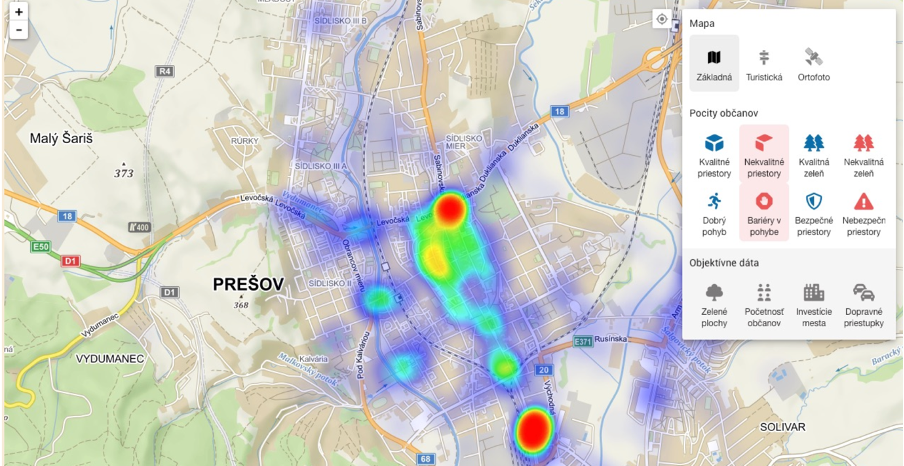
Traditional planning often treats residents as passive recipients of decisions made elsewhere. But participatory tools like “sentiment maps” flip this model entirely. Through such platforms, citizens can express their feelings about public spaces—identifying where greenery is lacking, which areas feel unsafe for cyclists, where parking is problematic, or simply where they feel comfortable versus unsafe. In pilot projects across the Prešov region in Slovakia, such tools gathered over 10,000 citizen sentiments from cities including Prešov, Poprad, Kežmarok, Humenné, Bardejov, and Vysoké Tatry.
Bridging the Gap Between Vision and Reality
Feedback from various stakeholders reveals both enthusiasm and obstacles. Citizens welcome the opportunity to easily and effectively express their opinions about public space quality, yet they recognize that local governments often lack established procedures for incorporating citizen input into planning. Urban planners see data-driven approaches as positive steps on the long road to improving collaboration with government representatives in regional and territorial development planning. Their analyses can serve as foundations for investors and developers who need to understand the needs and requirements of future residents based on objective evidence.
The Path Forward: From Data City to AI Factory
The ultimate vision is transforming cities into what might be called “artificial intelligence factories”—not cold, mechanical systems, but responsive organisms that combine technological capability with human wisdom. This requires partnerships across sectors: with regional governments and associations of cities and municipalities, with academic institutions on research projects, with developers on creating higher-quality public spaces, and with data offices on certifying data-driven cities. The goal is not to replace human judgment with algorithms, but to ensure that when decisions are made about where we live, work, and play, they’re informed by the best available evidence—and by the voices of everyone who calls that city home.
Contributors: Dagmar Celuchova Bosanska, Adriana Ciefova